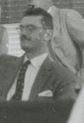
What a find!
Flickr user Cate came across a collection of old snapshots at a thrift store, and immediately knew there was something special about them - they were from the 14th World Science Fiction Society convention, held in New York in 1956![1]
See Cate's scan of the photos here:
https://www.flickr.com/photos/slomuse/sets/72157662390340119
(Discovered by me via https://boingboing.net/2016/01/02/help-identify-the-science-fict.html - additional text there)
Amazingly, in only a few days quite a lot of names have already been pinned to these photos, with much of the heavy lifting being done by Astrid Anderson Bear and Robert Silverberg themselves!
As of this writing, we have the following identifications:
 |
| Forrest J Ackerman |
Forrest J Ackerman (no period after the J please!) was a fixture of the fan community at the time, a notoriously voracious SF memorabilia collector, and literary agent for Asimov, Bradbury, Hubbard and others. Amazingly, he missed only 2 Worldcons during his lifetime, so I suppose it's hardly surprising to find him in this random collection of photos!
 |
| Anthony Boucher |
Anthony Boucher was editor of F&SF at the time of this con, and was also an author of mystery stories.
 |
| John W. Campbell |
Campbell was of course editor of Astounding at this time (later to be called Analog as we all know, right?) and the magazine got the Hugo for best pro magazine that year.
 |
| Lin Carter |
Lin Carter isn't as well known today as he ought to be, but until his death in 1988 he was an amazingly prolific writer with some great work on his bibliography - though in 1956 he didn't actually win any awards, being up against some pretty stiff competition. Also, he actually hadn't published that much in the 50s - his first
published novel didn't come until
The Wizard of Lemuria which came out in 1965 following mentorship by L. Sprague de Camp, who went on to write collaboratively with Carter on a number of Conan stories.
 |
| Ted Carnell |
Ted Carnell - a fan and deeply involved in organization.
 |
| Jean Carroll |
Jean Carroll - apparently closely involved with fandom at the time, but I'm afraid I don't know much about her and can only find brief references to her in the Journal. Anyone with more info?
 |
| Arthur C. Clarke |
Clarke was the guest of honor at NyCon II (and also won a Hugo for best short that year, for his story "The Star" published in
Infinity)
 |
| Hal Clement |
Hal Clement is another name you don't hear very much these days, despite the fact he was inducted as a Hall of Famer back in 1998 - in the day he wrote
hard SF, and what I always noticed most was how hard he worked to make his alternative worlds scientifically plausible - no giant mono-ecologies for Hal!
 |
| L. Sprague de Camp |
Does this gentleman really need introduction? Between his Conan stories and otherwise enormous bibliography I'm sure most serious SF readers have come across him often. The most interesting thing about him though might be that in an era when SF was very much either fantastic planetary romances or hard speculative SF adventures (rockets on the cover and all that) his interests in classical history and linguistics really come through in his world-building.
 |
| Frank Dietz |
Frank Dietz is really not someone most people would know of outside of fandom, unfortunately. His presence here is notable, however, because Dietz and George Raybin sued NyCon II chair David Kyle in 1958 in a dispute over funds, which ultimately led to the death of the World Science Fiction Society. He also founded the famous Lunarians society in 1956, and was probably drumming up members
while not on camera! (also, responsible for the (in)famous party in room 770 which lies behind the name of online fanzine File 770 curated by Mike Glyer)
 |
| Ron Ellik |
I'm not sure what Ron Ellik was notable for in 1956, but he was certainly active in fandom and in 1958 he was one of the founders of the fanzine Fanac, which promptly won an award for best fanzine in 1959.
 |
| Pat Ellington |
Once again, I'm not quite sure what Pat Ellington was noted for other than fandom at this time, but she later (1963) started a fanzine named Kim Chi.
 |
| Harlan Ellison |
Here's a shot of Ellison right near the beginning of his career! He was already establishing himself of course, but much of his career was still far ahead of him. Later, of course, he was noted for his controversial opinions and also for editing the
Dangerous Visions anthologies. If you haven't read any of Ellison's work from the 60s and early 70s you're really missing something!
 |
| Lloyd Eschbach |
Eschbach is another name rarely heard these days. To be honest, I'm not much familiar with his work - some of which is now in the public domain - but what he's most known for might be his work on the
Cosmos series, and for his comment in his autobiography that L. Ron Hubbard had commented to him about wanting to found a religion because "that's where the money is."
 |
| Nick Falasca |
Nick Falasca is another mostly forgotten name. Together with his wife of the time Noreen (who actually seems to be better remembered) he co-chaired the 1955 Worldcon in Cleveland, and later (1958) they also wrote Fandom's Burden, in which they expressed deep dissatisfaction with the WSFS (this seems to be a theme).
 |
| Ben Jason |
Ben Jason aka Benedict Jablonski was one of the co-designers of the Hugo Award (the rocket itself)
 |
| David Kyle |
David Kyle was the chair of NyCon II in 1956, and was emboiled in scandal over not only funds (see above for the lawsuit) but also for opposition to fans using the balcony overlooking the Hugo Award ceremony, leading to the in-group recognition signal "Dave Kyle says you can't sit here" which really sort of sums up a lot of fandom if you think about it.
 |
| Willy Ley |
Willy Ley got the Hugo for best feature writer in 1956, and was a well known space flight advocate and science writer.
 |
| Bob Madle |
A fan of note, but I'm not quite sure what his influence was.
 |
| Robert Silverberg |
Silverberg was awarded the Hugo for "most promising new author" (now John W. Campbell Award) in 1956, and, well, obviously he was promising indeed!
 |
| Roger Sims |
Roger Sims - deeply involved in fandom.
 |
| E.E. "Doc" Smith |
OK seriously, if you don't know who Doc Smith is get out there and read the Lensman series. Smith started writing in the 20s and was a major fixture in the genre community until his death in 1965 - his work on Lensman series and other writing earn him the title "father of space opera" though perhaps that doesn't do enough to reflect his influence.
 |
| J Ben Stark |
Later to be co-chair of Worldcon 26 in 1968, but I don't know much more about him.
 |
| Jams Taurasi |
James Taurasi was one of the people who started it all, being a co-organizer of the FIRST Worldcon in 1939.
 |
| Wilson Tucker |
Not an author I'm familiar with unfortunately, but it seems he was deeply involved in the development of the genre and particularly criticism - coining terms like Space Opera and the like.
Well, that's it - a snapshot of history as it were! There are still many faces unaccounted for in the photos, so if you're the sort who might be able to identify people head on over and add your voice!
--30--
1. This is of course
NyCon II, held August 31 – September 3